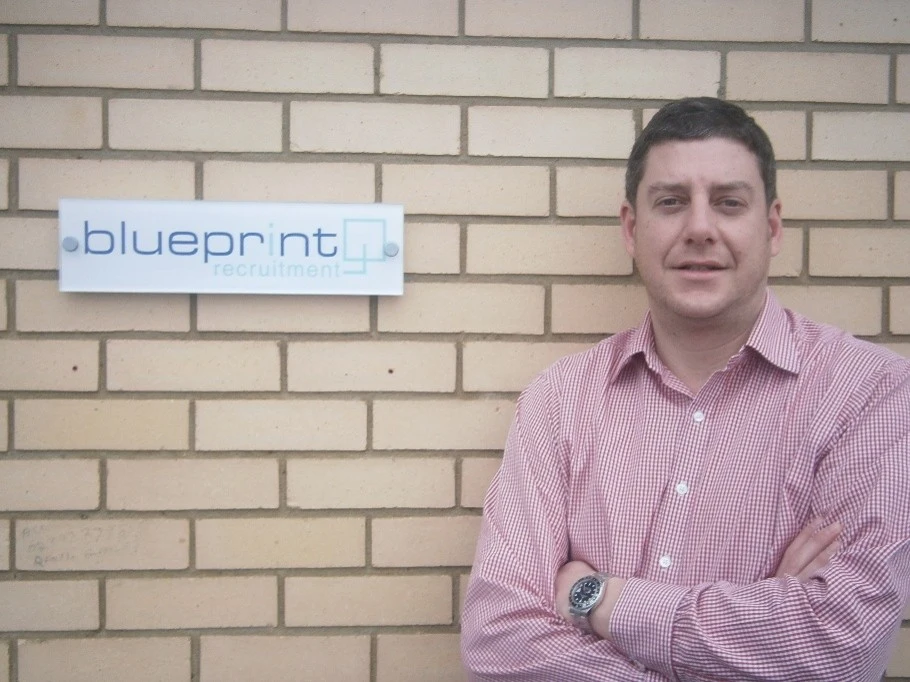
When Scott Formaggia was deciding where to begin his
recruitment career, Blueprint was not the obvious choice.
Larger, more established companies were offering clearer
paths on paper. Blueprint offered something different: a small team, a
windowless office in Gosport and the feeling that there was still something to
build.
Scott chose Blueprint.
More than a decade later, having grown from a new recruiter
finding his feet to a director of the business, that decision has come to
define much of his career.
As part
of our 20 for 20 series, Scott reflects on why he took the less obvious path,
the setbacks that shaped him and why Blueprint’s next chapter should be about
growth without losing what made the company different in the first place.
Choosing something different
Recruitment was never a lifelong ambition for Scott.
After graduating in Sociology with Politics, he spent a year
working at the University of Chichester before saving enough money to travel.
When he returned, he knew he wanted to build a career in something fast-paced,
people-focused and commercially driven.
Recruitment fitted.
He received offers from larger and more established
businesses. On paper, they arguably made more sense.
But something about them didn’t feel right.
“I remember thinking: are they even going to know my name?”
Blueprint was different.
It was considerably smaller and far less polished, but Scott
liked what he saw in the people behind it. Nobody was trying to oversell the
opportunity. Instead, he felt as though he was joining a business with
something to prove.
It felt early. It felt raw. And there was room to help build
what came next.
That was enough to convince him.
Then he saw the office.
The office with no windows
Blueprint’s Gosport office was not exactly a showcase for
corporate recruitment.
There were no windows. Pictures of the New York and London
skylines had been put on the walls to create the illusion of a view outside.
Facilities were basic and Scott was commuting from Littlehampton.
One morning, after heavy snowfall, he spent hours making the
journey to Gosport. Just as he arrived, a message came through saying the
office was closing for the day.
Sitting in the snow, it would have been understandable to
question whether he had made the right decision.
And the job itself did not immediately provide much
reassurance.
A difficult beginning
Scott is refreshingly straightforward about his first year
in recruitment.
“I was terrible at the job.”
For much of that first year, success was difficult to come
by. Recruitment did not click immediately and there were periods when Scott
wondered whether he was wasting everybody’s time.
There was no dramatic arrival or instant success story.
Instead, he had to learn.
Gradually, Scott began understanding the mechanics of
recruitment: how markets move, how clients think, how candidates make decisions
and why trust, timing and persistence matter.
Looking back, he believes struggling early ultimately made
him better equipped for the career that followed.
Early success can create confidence, but difficulty builds
something different: the ability to respond when circumstances change.
Scott learned how to pick himself up, work through a problem
and go again.
It would become an important lesson.
Growing alongside Blueprint
As recruitment began to click for Scott, Blueprint itself
was changing.
The move from Gosport to Cams Hall felt significant.
Suddenly there were windows. Air conditioning. A fitted-out
office on a golf complex.
Scott describes it simply as Blueprint’s “glow-up.”
But the transformation went far beyond the office.
The team expanded, the brand became more established and the
way Blueprint presented itself became increasingly professional.
Scott’s own career was developing alongside it.
He moved closer to the office, built his life around the
career he had nearly not chosen and progressed through the business.
What stands out to him now is the scale of the journey.
Having joined when Blueprint was still a relatively small
team operating from a basic office, Scott has seen the company develop into
something that would have been difficult to imagine at the beginning.
“It feels like a distant memory, but I can still remember it
perfectly”
The standards that stayed the same
Not everything needed to change.
For Scott, one of Blueprint’s most important constants has
been its approach to service.
The culture has matured. The company thinks more
deliberately about its people, policies and the perspectives needed to keep
improving. There are more structure and a much greater awareness of what a
growing organisation needs from its culture.
But the fundamentals of recruitment remain remarkably
simple.
Be honest. Be reliable. Be professional. Support people
properly.
Those standards have remained central throughout Scott’s
time at Blueprint.
And ultimately, they are what allow long-term relationships
to develop.
Learning to rebuild
Several years into his career, Scott felt he had reached a
significant professional high.
He had developed strong relationships, built a successful
area of business and felt that he understood the industry.
Then a major client fell away.
A substantial part of what he had built disappeared quickly.
It was a setback, but it also presented a challenge: could
he build it again?
He did.
In the years that followed, Scott rebuilt and eventually
surpassed where he had been before.
But he does not necessarily attribute that to suddenly
becoming a better recruiter.
The difference was time.
Earlier in his career, every opportunity felt like something
that had to be won from scratch. Years later, many of those relationships had
matured. Clients understood how Scott worked, knew what to expect from him and
trusted him to deliver.
That, for Scott, is the value of longevity in recruitment.
Strong relationships change the conversation.
Staying present when the market stopped
That philosophy became particularly important during COVID.
Almost overnight, recruitment markets changed. Projects were
disrupted, hiring slowed and uncertainty affected clients, candidates and
contractors alike.
Blueprint made the decision not to furlough its existing
team.
The message from Mark was that the business would keep
moving.
For Scott, that meant understanding what people needed in a
completely different market.
The team continued speaking to clients and candidates,
listening to the challenges they were facing and looking for practical ways to
help.
Blueprint remained present rather than disappearing until
conditions improved.
It was not about having every answer.
It was about staying close enough to the market to adapt
while circumstances were changing.
That period reinforced something Scott had already learned
throughout his career: when conditions change, relationships matter even more.
People buy from people
As Blueprint looks towards its next chapter, Scott is
conscious that growth can create another kind of challenge.
How do you become bigger and better without losing what made
people choose you in the first place?
For Scott, Blueprint’s independence matters.
Larger recruitment companies have advantages that an
independent specialist cannot necessarily replicate. Their scale, systems and
technology can be formidable.
But Scott does not believe Blueprint should spend the next
twenty years trying to become a smaller version of them.
“People do not buy from systems. They buy from people.”
Technology and AI will undoubtedly play a greater role in
recruitment. Scott sees significant opportunities to automate tasks, process
information more effectively and make parts of the job faster.
But he also believes there must always be room for human
judgement.
Recruitment involves decisions about people, teams and
working relationships. Technology can support those decisions, but Scott
believes the value comes from having someone who can question the output,
understand the context and recognise when something simply does not feel right.
For Blueprint, technology should strengthen the
relationship-led service it already provides, not replace it.
Growing without becoming something else
More than a decade after choosing Blueprint over the more
obvious opportunities, Scott’s reason for staying is remarkably similar to his
reason for joining.
Back then, he chose Blueprint because it felt like a
mission.
Now, he has seen what that mission became.
The windowless office has gone. Blueprint is bigger, more
structured and more established. Its brand has evolved; the recruitment
industry has changed and the technology available to the business would have
been difficult to imagine when Scott first walked through the door.
Yet he still recognises what attracted him in the beginning.
Blueprint was never the obvious choice.
That was the point.
It was smaller and less polished, but it had people who
cared, standards that mattered and the sense that something was being built
properly.
The challenge for the next twenty years is not simply to
keep growing.
It is to make sure that, however much Blueprint changes, it
never loses the things that made it worth choosing in the first place.
Because the real story is not simply that Blueprint grew.
It is that Blueprint grew without becoming something else.
.webp)